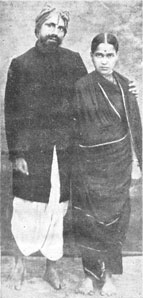
BHARATI
AND AFTER
THE
PEOPLE of Madras were shocked to hear the death of their
great poet, patriot and humanitarian. The newspapers expressed
public grief at the untimely death. Numerous letters from
the poet’s admirers appeared in the columns of the “ Swadesamitran
”.
The fiftieth death anniversary of the great poet was celebrated
throughout Tamil Nadu not very long ago on September 11,
1971. These fifty years had seen tremendous changes in
the history of the Indian people, both politically and
culturally. India had finally tasted of freedom and democratic
government for twenty five years out of this half a century.
In the ever-changing, fast-moving history of India, Bharati’s
name is imprinted as a national poet, and a devoted son
of Mother India. During the fifty years after his death
Bharati’s name has been heard the world over, and his
poetry has com to be treanslated in many languages, such
as English, French, German, Russian and the Czech, besides
begin translated in most Indian languages. There are numerous
cultural associations and clubs named after him in most
parts of the world. In 1948, a memorial building in the
name of Bharati and a bust were installed in Ettayapuram
solely on public contributions from the people of Madras.
Bharati has been honored by the Government of India with
a memorial postage stamp.
Bharati’s works have a long and complicated publishing
history. His wife, Chellammal, and her brother, Appadurai,
with the help of public donations, established “Bharati-Ashram”
and published some of his works, the two parts of Desiya
Githangal, Kuyil Pattu, KannanPattu and Bhaarati Arubattaru
in 1922. The sale of these publications, it must be noted,
was far from encouraging. Chellammal Bharati had commitments
in life, the younger daughter Sakuntala to be married
and the problems of day-to-day living which surrounded
even a poet’s widow. In 1924, while the copyright of Bharati’s
works was still with Chllammal, Bharati’s brother, Viswantahn,
Garihara Shama and Nataraajan, Sakuntala’s Husband, stated
publishing Bharati’s works by establishing a new firm
called “ Bharati Prachuralayam ”. Later, in 1931, the
copyright of Bharati’s works was sold to “Bharati Prachuralayam”
for the astoundingly small sum of Rs. 4,000. Most of the
money went to clearing the family’s debts to which Chellammal
had committed herself for her daughter’s marriage. “ Bharati
Prachuralayam ” published almost all of Bharati’s works-his
Desiya Githangal. Vinayagar Nanmanimalai in 1929, Devotional
and Philosophical Songs in 1930, collections of all his
poetry and prose and his English writings in 1937. Later
in 1941, the complete rights of Bharati’s works passed
into the hands of Viswanathan as the other two partners
of “ Bharati Prachuralayam ” withdrew from the venture.
The Government of Madras bough the copyright of Bharati’s
works in 1949 from Viswanathan, and Bharati’s wife and
the two daughters were given Rs. 5,000 each in settlement
of copyright. The Government under-took the publication
of Bharati’s works in 1954, and the copyright has since
become the property of the people of Tamil Nadu.
In the world of Tamil literary tradition, Bharati-literature
has been a turning point in launching a new era of style
in though and expression. Though Bharati belongs to the
age-long tradition of Tamil literature, and limits himself
in some places to the conventional banks, his poetry flows
with a racing vigour of contemporaneity, gushing with
new ideas and emotions. The course of its flow, its speed
and manner, its transgressions and its light are totally
new, and original in the finest sense of the word. Its
impact on modern Tamil literature has been tremendous
as it has given life and form to present day writing in
Tamil. Particularly, the style of prose and poetry, and
the way of thinking and feeling of the present literature
in Tamil completely and totally belongs to the Bharati-tradition.
Bharati is thus a revolutionary in Tamil literature, as
he bought new imagination, new techniques in poetry and
new ideals in thought.
Numerous scholarly articles, and poems in adoration have
been written on Bharati; about a hundred books have been
published on his life and works; he has been the subject
of scholarly research for the M.Litt., and Ph.D. degree
in universities.
Popular interest has been rousd in Bharati’s works, and
his life. There has developed almost a sense of devotion
towards him, elevating him to godly heights. As the poet’s
grand-daughter, I myself have heard numerous stories,
true and false, but imaginative, from all kinds of people,
both educated and uneducated, all stories displaying great
affection and devotion to their subject.
For Bharati, life and literature were not separate entities.
Poetry was the very essence of life to him, and life,
poetry itself. It is rarely that one sees a poet so steeped
in the principles of poetry that for him life and poetry
merge in a common identity. Bharati considered life a
rasa. According to him all worldly experiences-emotional,
intellectual or spiritual-became various rasa, and thus,
enjoyable. In one of his essays, Bharati rfers to the
division of the worldly experiences into nine varied rasas
which are the products of one rasa only, ‘the form of
Shakti’ or ‘joy’. To him all of life’s experiences were
desirable experiences.
This world is sweet; sweet is the sky and the wind.
The fire, the water and the land are sweet.
Youth and senility are sweet.
Saving is sweet; and so is being saved.
Destruction id sweet; and so is being destroyed.
Consumption is good; and so is being consumed.
Rasa is well; life is well….well….well.
Bharati’s poetry is an example of this rasa of happiness.
His work also reflects other rasas that are the variations
of this rasa of happiness. Such emotions as fear, sorrow
and anger appear in his poetry as the variations of the
same rasa of happiness. Nowhere do we find in Bharati’s
works an immersion in the shallowness of the other rasas
themselves.
Bharati’s attitude towards life was optimistic. He was
idealistic. Bharati should be studied though his poetry
a well as biography. P.Sri. a prominent Tamil commentator,
states how one can get details of Bharati’s life from
his poetry:
For the pot, the inner life is more important than the
external life. This inner life is expressed by a poet
only in his poetry. We get a complete picture of Bharati
though his poetry alone. When the poet forgets himself
and sings in a state of ecstasy, the revealing poetry
provides the essence of all his experiences of life. Here
and there, we find valuable historical information, particularly
many facts concerning his inner life scattered throughout
his poetry.
7