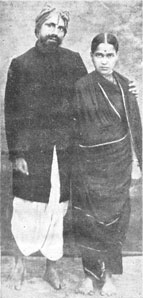
A
POET IS BORN
A
MAN’S personality is formed by the qualities of his ancestors,
his birth-place and the surroundings in which he is brought
up. Bharathi was born in Ettayapuram, in South India,
a place well-known for the great arts of poetry and music.
Its fame had spread through the southern part of India,
and Tamil scholars and musicians lined up to seek patronage
in the court of Ettayapuram.
Bharati’s father, Chinnasamy Iyer, was an erudite Tamil
Scholar and skilled in modern engineering and mathermatics.
He had tremendous influence in the court of the Maharaja,
and so Bharati was able to mingle with the scholars at
the court. Bharati has described in his Chinna Sankaran
Kathai, how he was influenced by the Ettayapuram court.
Though Bharati was a born-poet and gifted with the qualities
of a genius, he learnt the nuances of Tamil language and
poetry through his association with Tamil scholars of
the court of Ettayapuram. The title ‘Bharati’, a name
of the Goddess of Knowledge, was conferred upon him at
the age of eleven by the court, in approval of his ability
to compose poems on any subject, at any moment. He surprised
even older poets of his generation with his readiness
to compose.
Bhrati’s biographies point out that he wrote poetry at
an early age. His father wanted him to train in engineering
and mathematics, and tried to give him an English education.
He put him in the Anglo-vernacular School at Ettayapuram;
but Bharati hated English school! Education and was for
ever day-dreaming and writing poetry in Tamil. A genius
by birth contradicts common opinions of what a regular
education is. Bharati sings of Saraswati as keeping him
company in his youth and bringing poetry to him in the
caresses of the breeze. It is but natural that his mind
was distracted from bookish learning. Bharati’s wife,
Chellammal, relates how fond he was of ‘dreaming enchanting
day-dreams’:
Bharati could not concentrate on his studies. Even when
he was seven or eight years old he had dreams of an enchanting
nature and started writing poems of love and romance…
Even as a chills he used to sit with many older men and
discuss philosophical matters.
And:
At
the age of seven, poetry sprang from his voice. When he
was eleven he wrote in such a way that even learned men
praised him/ The title then conferred on him as Bharati
adds luster to his name. Bharati was not educated in a
scholastic tradition,
Says
poet Suddhananda Bharati. Somasundara Bharati, a friend
of Bharati, notes:
I
happen to know very well how Bharati’s father was greatly
complimented on his son’s talents in poetry. I have been
with Bharati in his eighth and ninth years when he could
sing on a given proposition with careless ease, and surprise
many older scholars and poets. I had laughed at the tales
about Kali writing on Kalidasa’s tongue, of Kamban’s power
of writing and of the tales narrating how Kumaraguruparar
composed poetry when he was hardly five years old. But
when I saw Bharati writing effortlessly at the age of
seven, I realised that these stories must be true, and
that the gift of writing poetry comes to a person not
through scholarship but through some power at birth. When
at the age of eleven he composed poems on lines given
by various Tamil scholars in an assembly of learned men,
he was awarded the title of ‘Bharati’ by the admiring
scholars.
Further
:
The
experience that belongs to very much older men was revealed
in the nature of young Bharati. He was a member of the
society of scholars when they gave out inaugural readings
of their works. He gave his opinions without flinching.
In his youth he enjoyed the friendship of great scholars
and the patronage of the State and lived very happily,
Says
Va. Ra (V.Ramaswamy), one of the poet’s close friends,
of Bharati’s early life.
Bharathi was mature in mind, proficient in the language
and had great talent for poetry. He had the poet’s love
of solitude and nature, pleasure in composing poetry,
sweet sense of rhythm and love of learning. Bharati’s
passion for wisdom and desire for learning are indicated
in his poem on saraswati :
I
was bewitched by her womanhood when I was merely a boy;
though the mind could no longer dwell on studies at school,
her face blossomed before me as she sat on white flowers
carrying a veena. I looked at her, and perceived the secret
of all learning and lost my heart to her.
Later, on the river-bank, as he sat in a solitary dome
and enjoyed the southerly breeze, she brought to him virgin
poetry. His youth was gifted with Nature’s silence, the
joyous experience of the southerly breeze, and filled
with day-dreams. This lasted till he became twenty two
and his attention was turned later towards other things
which he considered as important as learning and poetry.
Bharathi developed a fear for death later in his life.
H had seen two deaths in his immediate family, one at
the age of five when his mother died, and the other at
the age of sixteen when his father passed away. He used
to yearn for the love of his mother, and later he treated
all women with filial affection and considered them the
embodiment of Mother Shakti. He loved to use the word
‘mother’ quite often in his poems. Though he had enough
of maternal love from his stem-mother, it never really
substituted for him the love of his mother that might
have been. Bharati had a large number of relatives both
on his paternal and maternal sides, and enjoyed the company
of the scholars in the State, and so he spent his youth
quite happily writing poetry. Naturally, most of his early
poetry reflects this contentment with life.
The father influenced the son in more ways than one. Though
Chinnasamy Iyer wanted his son to be English-educated,
he was very proud of his son’s ability as a poet and Tamil
scholar. He never encouraged him directly in this direction,
but Bharati knew that his father loved Tamil poetry. He
sent his son to the Hindu College High School at Thirunelvelly
for studies which cost a fortuned in those days. Bharati
refers to this in his autobiography saying that, in spite
of spending a thousand rupees for his studies, he achieved
nothing except evil attendant on an English education.
Most of Bharati’s qualities were developed from his father,
his straight-forwardness and strong belief in truth, for
example. H developed his father’s anger as well. The son
also inherited the father’s intelligence and innocence.
In addition to these qualities, Chinnasamyh Iyer’s experience
of life influenced Bharati a great deal. Bharati never
relised the importance of money until his father lost
all his money in the cotton industry, and died.
Bhrati was married at the age of fifteen to Chellammal,
a beautiful girl of seven. The ceremony was big event
and took place of four days. Bharati sang love songs of
Annamala Reddiar at the wedding, admiring his wife’s beauty
and asking her for her love. Chellammal, the shy and modest
bride, knew even at that age that her husband was an extraordinary
person and was indeed very proud of him.
Chellammal was a source of inspiration for Bharati later
in life, and he sings adoring her in many poems which
express the heights of his advitic experience. Though
Chellammal was fortunate to have a husband like Bharati,
many were her sufferings on account of his political life
and his experimentation olf ideals in actual life. For
example, when Bharati was concerned about freedom for
women, he used to experiment them at home with his wife
and daughters; his elder daughter, under his supervision,
used to open the front door for his young friends asking
them to come in, and fulfil functions of hospitality,
offering them water to wash their feet, and so on. This
was not normal social practice in any village in those
days, and Bharati’s family encountered many difficulties
on account of such uncommon behaviour.
The year after his marriage, Bharati’s father died, and
this came as a great blow to him. He was greatly influenced
by this sorrowful experience, as his father’s death was
due to psychological reasons for his losing money in the
cotton industry. Bharati sings and insists elsewhere that
making money is the first duty for those who do not have
money. But he would never let money overpower a man’s
natural character. Later on in life, Bhararti was not
attached to money, though he had the necessity to earn
a lifing as much as anyone else. He was of a very generous
nature, and gave of everything he had to the needy. This
was a direct result of the experience of his father’s
death.
Bharati studied in the Hindu college High School for three
years till he completed the fifth form, and continued
his education in Varanasi, living with his aunt. Krishna
Sivan, Bharati’s uncle owned the Sivamadam in varanasi,
and lived a peaceful life of hosting pilgrims who came
to the city from various parts of the country.
Varanasi was a place which suited Bharati’s poetic personality
and hie enjoyed his stay there very much. The river Ganges
occupied Bharati’s poetic dreams, and he spent almost
all his leisure out of school in gazing on her beauty.
Bharati used to lose himself in the beauth of the river.
It was the greatest of natural sights and crated in him
a glorious experience of spiritual beauty. At the same
time, as a patriot, Ganges, besides being a poetical sight,
became for hism a symbol of the age-long culture and civilization
of India, an instrument bearing the weight of history
and the form carrying the spiritual power of this country.
Thus Ganes was the river of virtue, infused with extraordinary
spiritual power:
The Ganges of the holy and sweet water is our river:
Is there anything to compare with her glory?
Bharati regards the Ganges, as one of the ten limbs of
Bharata Devi any says that the holy water of the river
adds strength like nectar to the soil, puts life into
the earth and mixes the culture and dharma, born out of
spirituality, with the soil:
The Ganges has come down from Heaven growing gold and
dharma all along the path of her descent.
Bharati
must have stayed in Varanasi for two or three years (from
1898 to 1901?). He had to learn both sanskrit and Hindi
in addition to English to pass the Allahabad University
entrance examination. Bharati spoke Hindid as fluently
as a native speaker, and became conversant in manhy language
later in life, such as French, Bengali, Urdu and the Dravidian
languages, telugu and Malayalam. He ujsed to dress like
a north-Indian, with a moustache, a short-cut hair, a
long coat and a turban. This is the most popular of his
portraits that have come down to us.
Bharati
returned to Ettayapuram at the invitaition of the Maharaja,
when the latter came to attend a meeting in Delhi. The
Maharaja visited varanasi on his way back to Ettayapuram,
and asked Bharati to come and server in his court. Bharati’s
job entailed being with the Maharaja, entertaining him
by reading newspapers and discussing literature with the
patron. During this period, he read Tamil literature and
formed a group of friends to enjoy the beauty of Shellye’s
poetry. This was called the ‘Shelleyan Guild” and as a
mark of his admiration for the English poet Bharati called
himself ‘’Shelley Dasan,’’ and wrote under that pseudonym.
The
free-spirited Bharati could nto continue in his sevice
to the Maharaja as it was impossible for him to bear with
some of the courtly customs. Bharati wrote about his experiences
in the Maharaja’s court in Chinna Sankaran Kathai.
From
August 1, 1904, Bharati took the job as a tamil pandit,
with a monthly slary of 171/2 rupees in Sethupati High
School, Madurai. This lasted till November 10, 1904, and
his career as a journalist started after that in the ‘’Swadesamitran
office in Madras. There is some controversy about how
Bharati joined ‘’Swadesamitran””. When Bhrati was working
as a Tamil teacher, G.Subramania Iyer, the editor of “Swadesamitran”
came to Madurai; he reconginsed Bharati’s genius and asked
him to come to mMadras. Bharati resigned his job and went
to Madras. Another version of the incident is that Bharati
wrote to Lakshmana Iyer who was a distant relative of
Bhrarti and the vice-principal of the training college
in Madras, as his temporary job as a Tamil pandit was
coming to an end, and Lakshmana Iyer go him the job as
sub-editor in “Swadesamitran.” Yet another versionis that
Bharati asked a colleague, Ayyasamy Iyer, about the possibility
of a job, as his present job then was temporary, and Ayyasamy
Iyer’s uncle Rajarama Iyer who was a correspondent for
the “Hindu” recommended Bharati to the sub-editor’s position
in “Swadesamitran.” In any case, Bharati entered the field
of journalism, the chosen career of the rest of his brilliant
life.
Bharati
assumed the sub-editorship of “Swadesamitran” towads the
end of November 1904. This was the kind of work Bharati
had always wanted to do; free, intellectual, suited to
his character, a channel for his writing talent, and a
service for the nation, at this critical time in the nation’s
history.
1