ADVENTURES
IN JOURNALISM
AT
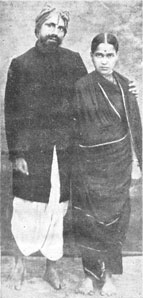
THE age of twenty-seven Bharati was in Pondicherry, a
charming, energetic and flourishing youth. Bharati was
a handsome person; thin and fair, with powerful eyes,
a broad forhead and a pointed nose, he was indeed good-looking.
His wife describes Bharati’s complexion as ‘golden’. Va.Ra.remarks
on Bharati’s physical appearance:
Bharati was a handsome
man, fair in complexion, a little taller than five foot
six, his nose was particularly pretty, the nose was carved
out becomingly on his face; the nose was not bent like
that of Caesar or Rajagopalachari. Caesar’s nose bridges
on high in the middle, is bent sharp in end and appears
to peak at any one. Bhartai’s nose was chiselled out beautifully
without a trace of ugliness through its length.
Bharti’s eyes were red-lined
like the lotus flower. The eyes that were the centre of
the face flowed like to balls of fire. It never satiated
one to look at them.
Bharati had a broad forehead
and a most ache kept in trim. It was not the pricking
variety of Kaiser’ moustache. It grow of its own accord
and appeared to smile with great jot and pride.
Suddhananda Bharati saw Bharati, and was bewitched by
his appearance. He describes Bharati as he saw him;
His courageous face as appears to me now seemed to sparkle
like a tower, and to tell one to be fearless and without
shame. The flaming eyes gleam before me now-the eyes that
were full of wisdom and courage. His moustache, unlike
Kaiser’ stood up like a tongue of flame. Such descriptions,
help us link Bharati’s physical personality with his inner
personality. A poet’s inner personality, in spite of his
physical appearance, speech and action all marks of an
outer or visible personality, remains invisible. The relationship
beween aspects of visible, out personality, and the invisible,
inner personality, remains open to discussion. A man’s
inner and outer personalities by definition, may appear
to be at variance with each other. It is common experience
that a wicked man may bear happy appearance and a right-eous
person may have an ugly exterior. This disparity in the
inner and outer personalities is of one kind; complete
harmony between the inner and outer personalities is a
different matter. Very few people are blessed with a complete
harmony n their personalities. Bharati belongs to this
class of rare and out-of-the-ordianry people.
It is known to use from his many friends that Bharati’s
exterior was as handsome as his inner, harmonious personality.
His poetry too reveals the harmonious blending of the
inner and outer personalities. In Tamil poetic tradition
it is held possible to determine the inner workings of
a man through his external appearance. The outer in some
measure reflects the inner form:
As the marble reflects a near object
Sol does the ace reveals a bitter hear,
The eye reveals friendship and enmity,
If you can read its language,
Says Thirukkural. The face indeed is the index of the
mind. Eyes are capable of revealing a person’s soul. Nature
constantly attempts to express a man’s nature by same
means of another.
Bharati’s friends have uniformly noticed the flaming splendour
of his eyes. Not only people who had known him when he
was alive but even those who see him in portraits and
photographs have noticed the courage and glory reflected
in his eyes. Even for a casual observer it seems as if
the wisdom of his mind and the light of his genius were
reflected in his flaming eyes. In an easy entitled the
Eyes (Kangal) Bharti speaks of the revealing quality of
the eyes:
Nammazhwar speaks of ‘the eyes that are red and large’,
when he describes the eyes of Lord Krishna. The eyes of
the sages too resemble those of the Lord. The eyes must
be like lotus flowers.
Looking at Va.Ra.’s description of Bharati’s eyes as ‘the
red-lined eyes like lotuses’, we may infer that Bharati’s
eyes revealed a sage whose soul had attained true freedom.
His eyes revealed his genius; they fascinated a casual
observer at the very first meeting; they revealed the
purity and bounty of his heart; their purity was born
out of the purity of heart. In the case of a harmoniously
blended personality like Bharati, the inner workings of
his heart could be perceived in his eyes.
When there is no falsehood, the eyes look straight. Behold!
When falsehood dies it is possible to look straight ahead.
When fear dies it is easy to look straight. Behold ! when
there is no false hood, there is no fear. Fear dies and
so does falsehood.
So writes Bharati. Purity
of the eyes is dependent upon a heart, free from falsehood
and fear. When the heart is false there is the fear of
discovery. Since the eyes must reveal the heart, they
dare not look straight. The light of truth sparkles in
a person’s eyes when he is without falsehood and fear.
The eyes then carry the flame of truth. Bharati’s eyes
reflected such fearlessness and truth.
Bharati’s forehead revealed
the nature of his intelligence, wisdom and poetic genius.
Though Bharati was lean, he was majestic. He was fascination,
and inspired awe and respect in anyone who came into contact
with him.
Bharati was always surrounded
by a crowd. When he came out one or two always followed
him. When bharati walked along Pondicherry roads people
who sat on their pyols would stand up in respect and with
folded hands salute him.
Bharati’s walk too reflected
the majesty of his appearance. His walk also revealed
fearlessness, by being rhythmical. As a born-artist, Bharati
expressed the harmony and rhythm of his being even in
his walk. Va. Ra. Describes the uprightness and rhythm
of Bharati’s walk:
Bharati never walked with
a stoop. He used to tell young men never to stoop. His
chest completely dry and without flesh, would come out,
his head will go up high as he walked on like a soldier.
Bharati was very fond of marching to the tunes of “ La
Marseillels “ and “ La Sombre De Muse, “ the French marching
songs hummed with a rhythm.
In consonance with Bharati’s rhythmical appearance devoid
of hunches, his inner personality was also harmonious.
The aspects of his physical personality must be studied
as they reveal his inner personality to a great extent.
Yet, the body has its laws and limits, while the heart
is limitless in its vastness.
* * * * *
During
the ten years of his life in Pondicherry, Bharati was
exposed to a great variety of experiences. Some of these
experiences were extraordinary in character. As a poet,
a patriot and a journalist, as a person and a humanitarian
he had experiences in this ten year period of self-imposed
exile that enabled him to evolve into a saint.
Life in Pondicherry began innocuously enough with the
first day of his exiled life spent in Chitti Kuppusami
Iyengar’s home, for whom the poet had carried a letter
of introduction from Srinivasachariar of Madras. He could
not stay there long, however, as the British police was
constantly persecuting people who helped Bharati, at the
same time warning potential patrons against him. Within
the month of Bharati’s arrival in Pondicherry “ India
“ magazine resume publication. To continue their nationalistic
work both Srinivasachariar and Thirumalachariar joined
the poet, come to life in Pondicherry from Madras. “ India
“ magazine had last appeared in Madras, British India,
in the last week of September, and resumed publication
in the French territory of Pondicherry on the 20th day
of October.
“ India “ magazine carried the motto “ Liberte, egalite,
fratenite, “ and appeared every Saturday from Etranger
Street in Pondicherry. The 15’ x 10’ size, sixteen pages
of the weekly, revolved completely round its editor’s
personality. Bharati was in contact with a wide cross-section
of the people, and was recognised as a great patriot and
political propagandit. His editing was very imaginatively
done, and the magazine took an almost entirely political
appearance. Its circulation in the Madras presidency became
quite wide, it spite of the British Government’s displeasure
with the newspaper and its editor.
“ India ” magazine became successful enough to claim a
circulation of over 4,000 copies weekly, literally a feat
for a vernacular newspaper in those days. As a journalist,
besides writing talent, Bharti had a good deal of experience
in the art of printing ad techniques of publishing. The
editorial, cartoons, pictures, presentation of matter,
quality of writing as well as the magazine’s layout and
type-setting contribute to its success. Bharati published
a political picture in the first page and wrote the commentary
of the picture and editorial on the next page. Bharati
found that ‘ truth ’ presented imaginatively made a havier
impect.
The picture which “ India ” carried every week on its
first page described metaphorically some important political
event of the week. This was a very effective political
weapon as it created the effect of a thousand words. It
attracted the people as well as the Government, leading
to the Government’s prohibition against the publication.
Bharati’ strongly believed that propaganda was the best
method to fight the British. He insisted on propaganda
as a successful political method later in 1921, when one
crore of rupees were collected for the freedom movement
by Gandhi throughout the country. He asked the leaders
to spend more money on propagating the ideals of nationalism
and the evils of the british rule in India.
“ India ” magazine thus became a powerful instrument of
propaganda in Bharati’s hands. He concentrated on two
elements, namely, the importance of political freedom,
and the injustice done to the Indian people bye the British
rulers. A simple truth in Bharati’s powerful imagination
assumed the force of its new appearance, and appealed
even to the most pedestrian mind.
An example is Bharati’s inclusion of the news item about
“ National Circus Company “ in Pondicherry. Bharati rendered
the ordinary occurrence so imaginatively as to convey,
besides the plain information, a subtle message about
the British Government. Bharati explained an accompanying
cartoon in the following manner:
A big stone is being carried by Venkatasamy of the National
Circus Company with many people on it. He is called the
Indian champion.
Wilson Circus.
Wilson, the finance minister of the British Indian Government,
the proprietor of that circus is levying a burden of taxes
with machine guns on them, on the weak people of India.
Besides being the editor “ India ” , Bharati also published
a daily called “ Vijaya “ from Pondicherry. “ Vijaya “
was first published from Madrs and later on. When the
poet moved to Pondicherry, the newspaper also moved with
him. “ India “ announced the arrival of the new daily
“ Vijaya “ from September 7. 1909. There came also the
Tamil monthly “ Karmayogi “ on the pattern of Aurobindo’s
English counterpart “ Karmayogin “. There followed an
announcement in “ India “ of December 4, 1909 that another
monthly “ Chtravali” a periodical devoted chiefly to pictures,
would be published and the pictures would be interpreted
both in English and Tamil. Whether this magazine ever
saw the light of day is yet to be determined by historical
research. In addition to these, an English magazine “
Bala Bharata “ was published from Pondicherry which had
the distinction of being edited by Bharati.
Bharati’s journalistic activity extended to articles,
poems and stories to other journals as well such a s “
Swadesamitran “, “Gnana Bhanu “, “ Aryan ”, “ New India
“, and “ Common Weal “. In its second year “ India ” magazine
published in a larger size and it was made clear to the
public that its objective was to propagate the three vital.
Principles of democracy, liberty, equality and brotherhood
and that it would never draw back from its ideal or stop
the holy war against the Britis rulers. “ India “ magazine
never let go of an opportunity to focus attention of freedom
and democracy. For example, the magazine felicitated France
on her republic day and offered its blessings. “ Vive
la Republique !”.
The format of the “ India ” magazine was divided quite
clearly to hold different subjects such as literary matter,
handicrafts, and miscellanea. In it was published Bharati’s
Gnana Rathnam, that marvel of Tamil prose, every week.
The magazine frequently published special numbers, and
was always resorting to new methods to hold the public’s
attention. Bharati published a series of little comments
entitled “ Contradictions “, this that the officials of
the British Government said at different points of time,
e.g.:
Lord Morley said some time ago that the British were ruling
India only for the benefit of the Indians; recently he
said that India was the life-spirit of their British properties.
Which one o thes statements is true?
“ India ” magazine ceased publication because of direct
and indirect attempts of the British /government to prevent
ist appearance. In one of his essays, Bharati discusses
barious problems of running a magazine in Tamil area.
Difficulties encountered by Tamil journals and newspapers
at that time were the lack of money and lack of support
from the Government. Bharati was convinced that Tamil
magazines, because they were careless, idle, and had no
knowledge of politics, or love of their language, and
because they were crazy about everything that was British.
In Bharati’s case, however, he had a trementdous knowledge
of politics and dexterity in handling a magazine He had
many disadvantages as well in running his magazines. One
of the problems with “ India ” magazine was that it was
not allowed to circulate outside Pondicherry. Money form
British India would not reach “ India “ office. In March
1910, the British Government imposed a law on journals
which at last put an en to “ India “ and one after the
other all the other journals also ceased publication.
*
* * * *
Bharati’s efforts at running
magazines stopped before the year 1910 came to a close.
The next five years were difficult years for the poet.
He tried to publish his poems in book-form. He had published
two volumes of his national songs earlier, one in 1908
(Swadesa Githangal ) and the other in 1909 (janma Boomi).
Another collection of philosophical poems appeared in
the year 1914 (Mada Mani Vachagam). Most of Bharati’s
great works were written in 1912. The Tamil translation
of the Bhagavad Gita, Kannan-Pattu, Kuyil-Pattu and Panchali
sabatham were among his other works in this period. The
first part of Panchali Sabatham was published that year.
During these years poverty
played a major role in Bharati’s life. Bharati describes
the torments of poverty in an ode to Lakshmi, the Goddess
of Wealth;
We shall surrender unto
the feet of Mother Lakshmi,
as this poverty is unbearable.
The heart is clouded by the smoke of insinuation,
The mind that takes a dislike even to the Vedas……
I am unable to bear this torment
Poverty in this world is a great torment as
It rings forth insult from the unworthy,
the comraderie of the lazy,
As a light that is drowned into the well,
All our efforts become fruitless.
Poverty
distracted him from poetry and the other blessings of
life:
How many days has this Chetty been lying for the sake
of money? False postponement …. Every day this torture
persists it is detestable, O Parashakti ! if you go on
subjecting me to such trivia, I will certainly become
an atheist. O Mahashakti! Who has seen your Presence ?
Who knows that you have knowledge? This world ……. All
right, all right, I am not going to abuse you now. Protect
me, I praise you…..
The disturbance due to the creditor has also come into
the picture. There is no money to pay the doctor. Confusion,
confusion, utter confusion. How many days, months , ears?
Parashakti, won’t you bless me with the habit of writing
poetry……. O Mother ! if the creditor continuously makes
me miserable and if I go on worrying about buying rice
and salt. How can I sing of you?
Nevertheless he had sufficient strength to face such poverty
In life. He was not afraid of poverty. Both my grandmother
(the poet’s wife ) and mother (the poet’s daughter) have
told me that Bharati boldly faced all the misery of poverty,
and remained at peace even at times we new was penniless.
R. Kanagalinkgam has the following to say on his preceptor’s
defiance of poverty:
There is a lot of difference
between Bharati’s mental state and that of other poor
scholars of his time. Bharati’s bhakti towards Parashakti
was deep. Because of this, he was always happy. His wife
Smt. Chellammal also never felt disgusted with life on
account of their poverty. I have never seen my guru of
his wife despairing.
But the poet’s life is truly the life of the inner spirit
which is invisible. Each person dwells in a world of his
own, in which all his joys and sorrows are experience
through his heart. The importance given to a life – internal
or external – depends on the individual according to is
vales of life. He is completed to follow the customs and
regulations of society and has to live in accord with
them. When faces something which is contrary to his own
ideals and feeling emotional conflicts appear. Since the
common man sets greater store by the needs and activities
of the external world he does not usually bother to listen
the inner voice of his consciousness. He suppresses the
conflicts, and adjust to society and its values.
On the contrary, the genius considers his inner life the
more essential and, therefore, seems to come into conflict
with the external activities of life. Bharati however
did not avoid the external world. While he emphasized
the importance of inner life, he did not shun the external
world altogether. Like the sages of the vedic period,
he found the external world an expression of his own inner
harmony. He tried to bridge the gulf between the inner
and the external worlds, and to establish an ideal life
in an actual world. As may be surmised, he faced many
difficulties and encountered much unfavourable criticism
from society around him.
Bharati yearned for Krutha Yuga to become established
at once in this world. Kurtha Yuga was to him the conception
of his ideals as expressed in the external world. He conceived
Kurtha Yuga in which the universe would be perfect and
without evil. He pictured a joyous world free from sufferings,
a world of enlightenment unmarred by ignorance, a world
which rejected superstitions, a world of progress that
had done away with corruption. Justice and wisdom lived
together in this paradise of his conception; here unity
and goodwill prevailed among men. Bharati tried to establish
this Kurtha Yuga in the actual world and to link both
the inner and the external worlds; but his attempt was
interpreted as insanity by the society around him. This
is a common enough experience for poets and geniuses of
this world in their own lifetime. But Bharati’s personality
was strong enough th endure such criticism and continue
to be firm in establishing his ideals in the outer world.
He had enough strength and tenacity of purpose to endure
the sufferings that came in the wake of his efforts.
Love was the basic emotion of Kurtha Yuga, preached as
a religion and a complete way of life:
I am fearless of anything, O men,
You embrace my religion……….
Your duty is merely to love, learn this.
Bharati’s
inner world was an abode of unbounded love. It was the
basic emotion in his personality, which dissolved all
the ugly passions of the mid and bound them into a wondrous
design of unity; he was able to unify all the forces of
his mid in a single harmony, with the melody of love to
produce a music of unity in his hearty.
The human mid is a large enough faculty to constantly
t produce heterogeneous emotions. Thinkers have always
striven to subjugate these emotions by intellect. They
employ intellect as an instrument to restrain the struggling
forces, which pull the mid in different directions. Bharati
recorded all the workings of his mind in his Chittakkadal.
His trials in attaining perfection began during these
years, and he described all the movements of his mind
so that he might conquer them, finally controlling the
mind itself completely:
We feel shy of writing about our weakness lest
Others should see them….. I am going to
Describe the movements of Bharati’s mind.
I and he are different persons. I am pure knowledge and
he
is a small speck conditioned by his ego. I am going to
control him and mend him.
Elsewhere
in Gnana Ratham the Chariot goes around “Gandharva Loka’
and visits every world on the way. In this attempt to
conquer his mind, Bharti adopts different techniques to
satisfy it. He writes of his extreme love for his mid:
I have great love for this beautiful maiden, the mid.
How O began to love here cannot be illustrated here. That
is a secret. But in course of time, my love towards this
beautiful girl has so increased that I have long since
forgotten that I and my mind are separate entities. Unable
to bear the sufferings of the mind, I desired to visualize
the Shanti Loka.
Out
of pity for the mind Bharati tries to take it to the world
of peace, but feels despair. Soon he concludes that the
mind should be killed in order that peace might be obtained.
There is yet another experiment to conquer the mind:
My opinion is that the mind which is a monkey, can be
conquered in course of time, by just going on writing
whatever it does. Before controlling an object we should
know all of its properties. The one which is not completely
known cannot be completely conquered. We should understand
the mind before conquering it. My conclusion is that if
we continuously watch its motions and write of them, its
qualities can be completely understood. O Parashakthi,
every moment, bless me with the necessary strength to
express the vibrations of my mind.
In his attempt to conquer his mind, Bharatil tried self-analysis.
His self-analysis was not the result of self-love or self-pity
for it was a sincere attempt to become free from ego in
order to conquer the mind. Self-control and perception
of truth (in objects) were the ideals of Veda-rishis.
Bharthi too, in the way of the Veda-rishis, tried to fee
himself from ego and reach for eternal peace. Bharati’s
was the method of selecting one of the emotions as the
controlling and guiding factor of all the emotions of
the mind, and utilizing it for their unification. Bharati
chose love, a powerful emotion, to master all the heterogeneous
mass of feelings. The principle of love does not analyse
the multiplicity of creation as does the intellect, but
with its magical power;, is capable of destroying all
evil and of establishing the good in a simultaneous effort.
Though love was the essential quality in Bharati’s personality,
there existed his ‘ego’ which was an impediment in the
development of his personality. It was a sort of encrustation,
covering the spark of love. In an ordinary man the core
of love world perhaps be covered by a thick layer of ego
and his personality would be self-centered with an extremely
small radius of love. In the case of a poet like Bharati,
the layer of ego was extremely thin and, with considerably
less effort, he could shed it altogether from his personality.
Bharati was well aware of his egotistic impulses, and
realized that unless this negative element was removed,
he could not reach the state of perfection which he called
‘ the state of the Devas’. He pleaded to Shakti to remove
his ego from his personality, and liberate his soul from
its bondage:
Will the heart get drenched?
Will it not be purged of its falsehoods,
Pride and other infirmities?
Will not the lie melt away?
Will the tears of devotion not flow?
In the flood of kindliness
Will this despicable dog not quench its desires?...
Slay my furious passion…….
Make my mind clear or make this body dead,
Lead me to yoga or slay this flesh.
This was the mind that existed in the loftiest state possible
but sometimes became frustrated and angry at the imperfections
of the outside world. It was Bharti’s desire to reach
a state of perfection inllife, over coming the faults
of his personality. It was his love towards humanity that
angered him as well. He could not bear the sight of an
insincere action, or a false superstition.
Alas ! what a world is this ! Constant cheating, constant
cunning, constant worry. There is no substance in it,
it is a hollow life……
Too bad, hopeless-is this earth a fit place to live? Can
a man live in this world? Tortoises and wolves can live.
This is the hell of misery. This is the origin of meanness.
One should not look even at the faces of those people
who do not hate this despicable world.
But Bharati firmly believed in the principle of love,
and thought that all memories of sorrow, weariness and
fear would be destroyed by love which itself never perishes.
He had this realization in life and so loved all beings
of the world. He perceived God in all beings and loved
them accordingly. Bharati’s love for the universe expressed
itself in curious ways. His feeding the crows and the
sparrows is an expression of his love for creation. Chellammal,
Bharati’s wife, has narrated a particular incident. One
day, Bharati kissed a small beautiful ass which was playing
in the street and the people of his village, who observedit,
thought he was insane. She comments:
Bharati was an Atma-gnani. He acted in the actual world
according to his principle that all created beings should
be equally loved. His actions may seem insane tol us.
Once he took a small ass over his shoulders and kissed
him…. People who looked on this treated this young, the
great gnani, as insane…… Poor little peasants used to
pick up small margosa fruits and collect tamarind leaves
for making fire. One day Bharati asked them why they were
picking them up. The replied, ‘Sir, we have nothing to
eat except these margosa fruits.’ Bharati joined them
in collecting the unripe margosa and tamarind fruit, and
ate them too.
From that day onwards he gave up his taste for food, saying
that all objects created by God were filled with nectar,
the divine drink. That margosa tastes bitter, because
we think it is bitter, and that if it was considered nectar,
it would accordingly taste sweet.
How to account for these incidents except ;by saying that
he perceived God Himself in the beauty of the ass, in
the appearance of the crows and sparrows, in the sourness
of the unripe fruit, in the sweetness of recipe fruit,
the coolness of the breeze and in the heat of the blaze,
and that he live up to his ideal of perceiving unity in
diversity?
These incidents date back to Bharati’s life in kadaya,
his wife’s native village, after he returned to British
India form Pondicherry. The seed of this great realization
had already been sown while he was still in Pondicherry.
Poverty and the need to live in accord with society brought
untold sufferings and misery to Bharati and his family.
His experiences during hits period were unique and typical,
for Bharati not only responded as a poet but as an ordinary
human being as well. As a patriot opposing the exploiting
government, and as a reformer keen on abolishing the caste
system and superstitions that perevailed in society at
this time, He came across stange experiences of life.
This uncommon incident is reported from his Pondicherry
days:
It was eight o’clock in the morning. Byl chance, I came
to Bharati’s house from the Aurobindo Ashram. There was
a small gathering in the verandah of the house. From the
centre of the verandah smoke was coming out. It looked
as though somebody was lighting a fire. Some people were
uttering Veda_mantras. Bharatis was seated beside the
fire. An untouchable boy, Kanakalilngam was sitting next
to him. There were also present some scholars like Professor
Subramania Iyer. I asked the professor what was going
on. He said, ‘ Kanakalingam’s holy thread ceremony is
just over and he is learning the Gayatri-mantra now.,
I again, asked him, ‘ Is is the untouchable kanagalingam
who is seated there?’ ‘Don’t you doubt it,’ the professor
replied, ‘he is the same person. Bharati is teaching him
Gayatri-mantra.’
Bharati
believed in abolishing the caste system to the extent
of selecting a non-Brahmin from the them considered most
backward community, and making him wear the holy-thread,
thus emphasizing the importance of equality of all castes.
Bharati who felt God’s presence in all beings treated
untouchables as his own brothers and ate with them in
the same row. Kanaglingam who wore the holy thread under
Bharati’s compulsion writes:
In the olden days when caste system and untouchability
prevailed in the country, Bharati not only invited the
untouchables to his house but gave them a permanent place
in his heart…. My guru Bharti shared the joys and sorrows
of the untouchables as Mahatma Gandhi does today.
In spite of these varied experiences Bharati led a happy
life as life was poetry to him. He considered all the
aspects of life-positive as well as negative- s the expressions
of life-poetry. He patterned his own life fully suggesting
the power of the soul which is infinite, and beyond the
ken of ordinary minds.
3