A POET’S POLITICS
BHARATI
was a great devotee of Shakti. It cannot however be said
that he followed the pattern of worship called saktham.
Shakti is a movement that is full of strength and life
and speed, attraction and vigour. Bharati’s ideal was
to possess in his soul and spirit, body and mind, great
vigour, and attaining this became for him a way of life,
a religion. He describes in his poem “Shaktikku Atma Samarppanam”
the way to attain shakti in life.
Make
you had might.
Let
it have the power to break away stones.
Make
your vision powerful.
You will have good sight;; you will develop truth and
kindliness in your vision.
Make
your ear sharp.
Good
music will flow into it; let it receive good messages.
Train
your nostrils in such a way that they are capable of
smelling sweet things only.
Make
your body strong.
It
will help you conquer death and liv long.
Make
your voice powerful.
Make
your shoulders capable of withstanding any
weight.
Embolden
your heart; fear will flee from it.
Make
your stomach capable of degesting anything.
Make
the loins powerful; your offspring will ge good.
If
your feet become as strong as steel they will have the
strength to go where they wish to go.
Make
your mind powerful.
It
will always rejoice, and forget unhappiness.
Good
thoughts, order and strength will come to it
It
will be full of shakti, spreading shakti everywhere,
and it will accomplish all things.
It
will be full of force and save you from evil deeds and
evil consequences.
It
will grant you your desires.
It
will increase beauty and grace.
It
will perceive good writings
The
light of truth will flow into it.
In this endeavour to make his body, mind and spirit powerful,
he tried all possible methods of exercising the body,
and followed Bhakti-yoga to strengthen and purify his
mind and spirit.
Though Bharati was handsome in appearance, he was not
very strong in structure. In fact he was quite thin, lean
and famished. He tried to strengthen his body bye getting
trained in sword-fighting which eventually he could not
continue to do. He used to take long walks on the beach,
in the beautiful places close to Pondicherry. He would
look at sunlight as he believed that sunlight was capable
of making his eyes powerful. He was very careful in his
dietary habits. He never ate left-overs. Even food freshly
cooked in the morning became un acceptable at night if
left over. He would fly into a age if he saw some one
not conforming to his own ideas of eating.
He was no very strong in mind either. He could never bear
anyone suffer for lack of anything- food, clothing and
shelter- and on account of disease. He used to give away
everything-his coat and every piece of clothing regardless
of the person’s need. He was as scared about disease as
he was about death. Bharati’s life abounds in instances
in which one or more of these charactereistic were expressed
clearly.
Once his younger daughter, Sakuntala, fell ill. The child
could not open her eyes in high fever, and Bharati became
so restless and sad as to plead to Shakti for the recovery
of his daughter. He did not have money to pay the doctor,
but the doctor was content to hear Bharati sing the song
“ Bhaktiyinale” in lieu of his fees. The poem is an example
of his unshakable faith in Shakti.
By bhakti the mind will be chastened
Order will be established in all actions.
To Bharati, bhakti meant faith. Bhakti is the realization
that the contradictions in this world are illusory, and
there is a unity pervading all the contradictions, a unity
which we will ultimately join. Being one with the harmony
of cration and finding the joy of this unity without always
being in a nervous hurry is bhakti. Bhakti brings forth
an orderly life, peace and supreme joy. As Bharati lacked
in physical and mental strength, he would strive to attain
strength again and again, with his belief in Shakti.
Once a friend of Bharati, who was a victim of leprosy,
came to see him, and with great enthusiasm he took Sakuntala
in his lap. Bharati would not hurt others’ feelings and
so kept calm, exercising great restraint. After the friend
left, at once he gave Sakuntala a bath after applying
kerosene oil wherever she had been touched by the leprous
friend. His fear of disease and death was so strong that
he began a search for a way to become immortal in this
world. One day, in the early morning, he happened to hear
the following song of one of the siddhas by a pandaram
who was trudging along the street:
The breathing that is regulated in sleep
May turn its course, and be gone.
Bharati was shocked to realize the truth of these words,
and he wrote his thoughts inspired by this lore in an
essay, In Search of Immortality:
When
I listened to this song, I became very thoughtful. What
is this? When the body is so uncertain what can we begin
and achieve in this world of uncertainties?.... Great
is the wisdom needed. There must be great courage of heart.
There must be learning; fame; wealth, and we must render
our relatives, friends and people around us happy in their
lives. We have great desires. If these goodly desires
have to succeed, we must lay a good foundation and must
build step by step. It is not possible to create lasting
happiness in a short span of time…. Time is required for
attaining knowledge of the self… When the next moment
is uncertain, what to cherish?
Bharati
followed Kullachami who led the way to show men immortality.
He introduces himself as a siddha in Bharati Arubattaru
and considers himself an immortal, who had come to establish
Krutha Yuga in this world. In a poetic play called Viduthalai
he portrays that all the powers of Indra, Agni, Vayu,
Jyoti, Maruthu and other divine powers contribute to him
their strength and bring him out of his stupor; they ask
him to bring order into the human face. This is this excuse
for wanting to live eternally in this world by controlling
his body, mind as well as his spirit.
It is generally believed that siddhas had mastery over
the art of living long years by strengthening their bodies
through kayakalpa methods. To send the Sushumna, Swadhisthana,
Manipura, Anahata, Visuddha, Ajna and Sahasrara through
certain ordained patha is part of their way of life and
the eight siddhis namely anima, laghima, prapti, prakamyam,
mahim, ishitwa, vashitum and kamavasayita are attained
through such methods. Bharati has described in his works
his meetings with many such siddhas, and his understganding
of their extraordinary powers. But, nowhere do we find
any evidence of his having tried to follow their pattern
of life himself by putting the body to hardship or by
controlling the breathing-system except that he did some
exercises sporadically. Bharati discovered bhakti-youga
as his way of controlling the mind and spirit. He believed
that the spirit could be controlled by exercising control
over the body and mind.
Control the body;
You may control the life.
But,
for several reasons, Bharati’s health was deterioratilng
through the years, and he did not live to be more that
thirty-nine years in this world. The hardships he had
experienced in his life, the heart of a poet which was
naturally under stress of various emotions, his passion
for freedom and not getting it, were some of the reasons
which frustrated him mentally sometimes and effected decay
in his body. He tried again and again till the day of
his death to straighten himself in all respects with the
power of his will, hope, and finally, faith in God.
*
* * * *
After
1915, Bharati started writing for the “ Swadesamitran
” again at a salary of thirty rupees a month, irrespective
of whether he contributed or not to an issue. In the meantime
the control of the British police indirectly over the
political figures in Tamil Nadu became excruciating, and
Bharati was not able to get any help either from Pondicherry
of outside the French territory. Even if he came by some
money, it would not last in his hands for a day. Many
attempts had been made by the British police to force
Bharati out of the French Territory. Once when he came
across such an incident of an act of treachery by the
British police, Bharati composed the poem “Pagaivannukku
Arulvai”, He never became angry with the traitor but simply
forgave, and even loved him following a principle that
even the enemy should be loved as a mark of God’s presence
in all beings.
Bharati
found the life in exile intolerable, and decided to leave
Pondicherry with his family. After World War I ended,
in November 1918, he came out of Pondicherry, and courted
arrest in Cuddalore. Chellamma and the family went back
to Kadayam, Chellamma’s native village, and Bharati wa
released from Cuddalore jail after some time with the
help of Rangasamy Iyengar and other friends. Bharati then
went to live in Kdadayam for about two years, till the
end of November 1920.
Kadayam
is a beautifyl village situated near the east-coast mountains,
in Tirunelveli District. Though the village is quite small,
it abounds in natural beauty and a spiritual atmosphere
pervades the scenery. There are quite an few temples around
the village, and Bharati became accustomed to taking long
walks, to enjoy the beauty of nature in these resorts.
The Nityakalyani temple stands about three or four kilometers
away from the village, and Bharati sings of Her in great
love. At the foot of the mountain, in a Kali temple, Bharati
sat and litened to the music of the birds thrilled to
a mood of poetic frezy. At noon various birds assembled
thre-sparrows, parrots, nighteingales, crows, the naganavai
birds and numerous others, The misic of the birda created
in Bharati varied imagingings and effected or in his poetical
thoughts. His inner ear was capable of keen concentration
on the nuances of the complex sounds around him and he
attempted to capture the varied noises, and to express
them in Tamill words similar in sound structure. ‘Ranga’,
‘Dairya’, ‘Jiva Jiva’, ‘Siva Siva’ ‘Kottada’ are some
of the words which Bharati assembled from the bird noises.
Bharati’s Jagat Chitram was born out of his experiences
in these places where a man could realize the vastness
of the universe and his own relatively insignificant place
in it. The blue mountains. The vast skies and the firmament,
the light of the sun, the birds-all together produced
in him poetic emotions. From the language of the birds
Bharati learnt a new way of life, a life of freedom-tatal
freedom in all respects-and the principle of immortality.
During
this period, Bharati was living in a house situated at
the west end of the street. There was a temple of rama
where many festivals were held, and great musicians were
brought to perform at the festivities. Bharati, himself
a great lover of misic and a musician, enjoyed these festivities
greatly. Sometimes he would lead the early morning Bhajan
groups which wen though the streets singing the praise
of Lord Rama. On one such occasion he composed the poem
“ Nandalala” , a piece which attains to the heights of
philosophic experience. Bharati believed, and sang that
if he surrendered at Lord Rama’s feet, he would never
die, and live inthis world for ever.
Political
and patriotic activity for Bharati continued in visits
to nearby villages to Kadayam, and speaking to small audiences.
Pottalpudur is a small village near kadayam where there
is a predominant Muslim populations. Bharati once visited
this place, and spoke to a Muslim audience on Islam. As
Bharati was as proficient in matters of other religions
as in Hinduism, his talk on Islam and Loran became a memorable
experience to the community. It was onthis occasion that
he composedand sang the poem “Allah”, a piece unique for
its intene religious experience.
A
meeting between Bharati and Mahatma Gandhi cameabout in
March 1919, when the latter visisted Madras to consult
with congress leaders befor launching a movement against
the Rowlatt Act. As Va. Ra. describes the incident , Bharati
met Gandhiji in C. Rajagopalachari’s house where he was
staying. There were Gandhiji’s secretary Mahadev Desai,
Adinarayana Chettiar, A. Rangasamy Iyengar who was theeditor
of “Swadesamitran”, S. Satymurti Rajaji, Va. Ra., and
others surrounding the Mahatma. Bharati entered and sat
besides Gandhiji and asked him if he could preside over
a meeting in which Bharati was going to be the featured
speaker.
Gandhji
enquired Desai as to his engagements for the day, and
as he had another engagement, he asked Bharati if he could
postpone the meeting for the newxt day. Bharati said this
was not possible, and blessed Gandhiji’s movement and
quickly took his leave. Gandhiji asked who his visitor
was and Rajaji answered that he was a nationalistic poet
from Tamil Nadu, On hearing this Gandhiji sems to have
remarked that good care must be taken of such poets as
Bharati.
Bharati
paid a poetical tribute to Gandhiji later. In a poem forecasting
the freedom of India by Gandhiji’s non-violent methods
Bharati speaks of the Mahatma:
You have brought into politics a spiritual
awareness and courage-
Politics that is entwined with war, murders
and chastisement-
To
regard all human beings children of God and to perceive
in them forms of Godliness,
To
regard one’s own life on a par with other lived that
may be full of evil-
…..All
this you have done.
This poem must be dated later in 1921 because Bharati
wrote an article about his own ideas against Gandhiji’s
non-cooperation methods in “ Swadesamitran” in November
1920. This essay is in the form of a reply to friends
who were asking him in letters and in person, about his
ideas of the Mahatma’s non-cooperation movement.
In later years of his life, Bharati was evolving into
an Atma-Gnani, and both inwardly and outwardly he seemed
to be flooded with love and bhakti. Such an attitude made
him very hopeful of attaining freedom by peaceful methods.
Though he suggested in the article mentioned earlier,
that people of India might get freedom by immediately
following the final stages of non-cooperation methods
such as non-payment of tax, he was quitted certain that
refusing parliamentary seats, and attorney ships and students
quitting schools-were not the proper means of achieving
the required results of independence for India. He was
convinced that there were too many chances of losing lives
and property by violating some of the laws of the British
Government, and thought that this method might lead the
country to a state of destruction and confusion.
Bharati suggested alternate methods in this article such
as propagating the principles of nationalism among the
people clearly and strongly, and peacefully attacking
the British at the proper time. His love of the country
and the people was such that he did not wish to lose anything,
anything at all, by methods other that peaceful. He concludes:
It
is obvious and certain that the time, circumstances and
the benevolence of God are in our support to attain freedom,
without any confusion. Why should we follow the path of
perplexity in which we might endanger life and property
of our countrymen?
Bharati made it clear that “Swadesamitran” and himself
as editorial writer were not against Gandhiji personally,
but were against some of Gandhiji’s methods,. He wrote
clearly that it was a matter of disagreement between nationalists
in their ways of approaching the same problem with the
same goals in mind.
Bharati supported many of Gandhiji’s efforts, however.
In 1908, Bharati published a cartoon in “India” magazine
showing Gandhiji as a cow in the midst of South African
officials pictured as wild tigers. In the year 1916, Bharati
wrote an appeal to the public, asking them to support
Gandhiji in his efforts to effect legislation to prevent
Indian people being forced to serve in other countries
on contract employment. In the year 1921, a month before
his death, Bharati wrote an article in “Swadesamitran”,
urging the necessity of spending more money in propagation
of nationalistic dials throughout the country. He expressed
great concern about not wasting the hard-earned money
of the people, and spending it properly aimed directly
towards efforts to attaining freedom for India.
Bharati realized in the end, before he died, that only
Gandhiji could lead the Indian people in their struggle
for freedom, and his methods would certainly bring forth
the desired results. Though he was greatly disappointed
in his own frustrating struggles with the British Government,
he still die not lose hope with Gandhiji methods of non-violence
to attain freedom.
After coming back to Kadayam in May 1919, Bharati sent
two verse- letters to the Maharaja of Ettayapuram seeking
his patronage. “Chitukkavi” is a poetic for in Tamil in
which the poet describes his own reputation and ability
as a poet, and praises the king asking him to reward his
poetic talent with patronage and generous gifts. Bharati
was aware of his own poet, and praises the king asking
him to reward his poetic talent with patronage and generous
fifths. Bharati was aware of his own poetic talent, and
the extraordinary quality of his poetry. He knew that
his poetry was translated into other languages such as
French and English, and he was rightly proud of such recognition.
So, whatever he wrote in the poems to the Maharaja was
the outcome of his critical judgment of his own poetry,
and entirely factual. The response from the Maharaja was
disappointing. The poems themselves are examples of Bharati’s
extraordinary poetic talent, and have an immortal place
in the galaxy of Tamil poetry.
Bharati visited places in Chettinad-Kanadukathan and Karaikudi,
and wrote in praise of the Hindu Madabimana Sangham in
Karaikudi. Some photographs with the members of the sangham
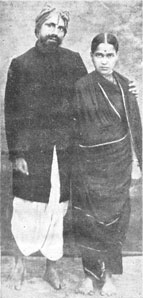
have come down to lust. Bharati appears in these photographs
with his usual black coat, turban, moustache and with
a long walking stick.
Though Kadaym was a place well-suited for Bharati’s poetic
Yearning, the people in the village were very backward
in many respects. The Agraharam where Bharati lived was
dominated by Brahmin power, and the Brahmins were against
Bharati’s principles and actions. He was treated as an
outcaste and became too restless to continue to stay in
that atmosphere of overpowering prejudice of the people
and their meaningless religious customs.
Bharati decided to leave Kadayam, and resumed his life
as the sub editor in d in Madras towards the end of 1920.
*
* * * *
Meanwhile, Bharati had been trying to publish some of
his works. He wrote a letter to Nellaiyappar on December
21, 1918, on reaching Kadayam after his release from the
Cuddalore jail, asking him to come over to Kadayam to
discuss the publication of his works. Again in 1920 he
sent printed circular letters in English to some of his
friends about his plans for publishing his works. The
letter which he sent to R. Srinivasa Varadacharya at Madurai
makes interesting reading as reflecting Bharati’s state
of mind at this time:
Om Shakti (in Tamil)
| C.
Subramania Bharati |
Kadayam
28th June, 1920 |
To,
R. Srinivasa Varadacharya,
Madurai.
Dear
Friend,
All
my manuscripts- the accumulated labout of my 12 years
exile – have arrived her from Pondicherry. There are to
be divided into 40 separate books; of each book I print
10,000 copies for the first edition. This work will cost
me an initial outlay of Rs. 20,000. And, within one year,
or, at the most, two years from the date of publication,
I shall certainly be able to get a net profit of a lakh
and a half rupees.
Most of the works which I have now selected for publication
are prose-stories, sensational and, at the same time,
classical; very easy, lucid, clear, luminous and all but
too popular in style and diction and, at the same time,
chaste, pure, correct, epic and time-defying. This fact
and(2) the ever-growing increase of Tamil-reading men,
women and Children in the Tamil land and the Tamil world
overseas; (3) the historic necessity of my works for the
uplift of the Tamil land which, again, is a sheer necessity
of the inevitable, imminent and Heaven-or-dined Revival
of the East; (4) the novel and American-like improvement
which I propose to make in the printing, binding and get-up
of my editions-which, aided by the beautiful and suitable
pictures illustrating the interesting events occurring
in the stories, will make them a tremendous attraction
to our public and such a wondrous surprise; (5) the comparatively
low prices of my books; for I am going to sell my prose-works
uniformly at eight annas a copy and my poems at, so far
as possible, for annas a copy; and (6) my high reputation
and unrivalled popularity in the Tamil-reading world due
to my past publications-all these are bound, most evidently,
to make my sales a prodigious success.
Please send whatever you can send as loan towards the
printing expenses. I expect from you at least Rs. 100.
Kindly induce at least twenty more of your friends to
lend me similar and much larger sums, if possible.
I
shall give stamped Promotes for the sums I receive from
your and your friends , paying the generous interest of
2 per cent per month in view of my large profits. Expecting,
very eagerly, you kind reply and scores of money orders
from your side and praying to god to grant you a long
and joyous life.
| |
I
remain,
Yours faithfully,
C. Subramania Bharati |
N.B.-
All Government restrictions against me have been removed
and all accusations withdrawn and so Government officials
may also be asked to subscribe for this loan. Nobody’s
name will be announced to the public in this connection
and the subscribers will be merely treated as private
creditors. THE DEBTS WILL BE FULLY CLEAR ED WITHIN 2 YEARS.
C.S.B
Bharati never had any response tol his circular letter
sent to his friends: he still did not lose his hope of
publishing his works. Again, when he served as sub editor
for “Swadesamitran”, he printed publicly a notice from
“ Tamil Varappu Pannai ” consisting of the same details
which he mentioned before in addition this time to reiterating
his reputation in other countries also. He quoted from
“Common Weal” (December 8, 1916) an article written by
James H. Cousins about the Belgian poet Verhaeren in which
his poems were noticed:
The
seeing eye apprehends Beauty not only in the thing seen
but though it; and the more faithfully the thing is
seen as channel and symbol, the more certainly will
both it and the seer be dignified, not degraded. Verhaeren
came within sight of imaginative freedom; but it is
in the poetry of Tagore and Naidu, Chose and Bharati,
and their spiritual comrades of the Irish School that
the purest and truest expression of realized Beauty
can be found.
This
was early in 1921 and Bharati was greatly disappointed
to get nothing out of his publishing efforts. Bharati
made some arrangements to start a new magazine “Amirdham”
from January 1921. He wrote letter is August 1920 to Strinvasa
Varadacharya of “Desabhaktan” magazine asking him to come
over to Madras and collect money for the publication of
“Amirdham”. He was not able to start this magazine either
as there were no sources of income at all for the proposals.
It may be noticed that Bharati who stated his literary
career as the sub-editor of “Swadesamitran” was still
in the same positional the point of his death. The destiny
of poets, like the destiny of kings, is uncertain indeed.
5