A
CIRCLE OF FRIENDS
PONDICHERRY
Was a place of inspiration for the poet Bharati. There
were many solitary haunts that created an atmosphere of
close communion with Nature. There was a beautiful manga-grove
to the west of the lovely city of Pondicherry where Bharati’s
Kuyil Pattu was conceive and write. The manga-grove was
the property of Vellachi Drishnasamy Chettiar. There Bharati
used to go and spend hours at a time, oblivious to the
world in his poetic frenzy. The song of the koel and the
atmosphere of beauty and joy inspired him to express an
experience of absolute beauty in poetry. Va. Ra. Speaks
of Bharti’s effort in bringing out his experience in words
and though rhythm:
Sariga-ga-gama
- it should be known to the people around him that he
is thinking of a new poem. He would shout in a high pitch
of voice sa sa sa .. sa sa sa.. without a break in breathing.
He would beat time with his right foot; if the time slipped
he would kick the earth with his left foot. Silence for
a moment …. He would shout praying for the gift of words,
would sing on e of the musical stanzas of Thayamanavar….
Again, for the second time, Sariga-ga-gama.
This can only be compared to the labour pains of delivering
a baby. It is a sight of privilege to see enthusiasm and
weariness come out together. It could be seen that Bharati
at that time ceased to relate to the ordinary human world.
The force with which the new song appears seems almost
to break his body. It is no exaggeration to say that Bharti’s
poems are full of the element of blood and life-giving
spirit.
Elsewhere Bharti has described the noises of a 10 o’clock
in the morning as heard form his corner:
On all the four sides the voices of crows, interrupting
are the noises of parrots and doves, in the street the
noise of a kavadi carrier, the sound of the temple-conch
at a distance, the proud crowing of a cock in the street,
infrequently the chatter of women walking down the road,
the cries of children in neigh boring houses, a beggar’s
voice calling out ‘Narryayana, Gopala’…. The sounds of
dogs barking, noises of doors being shut and opened, some
figure on the street clearing the throat lightly…. The
noise of a vegetable vendor at a distance, the noise of
a rice vendor- all these kinds of noises seep into my
ears gradually.
Bharati
transformed all these noises into varied forms, in making
his poetry, and was capable of preserving his inner harmony
so that all these noises turned to become poetic elements,
ceasing to be mere disturbances.
Though the poet perceives harmony in all noises of the
world, nevertheless, he too is subject to inner conflict.
He seeks the grand silence of nature in order to harmonies
his inner faculties. The silence of nature draws both
the inner and outer faculties of the poet to itself producing
in the poet a state of harmony which may be roughly termed
as a state of poetic frenzy.
Nature in all her manifestations was a source of inspiration
to Bharati and he loved to be in an environment of natural
beauty. There was a grove of cocoanut trees also, the
property; of Krishnasamy Chettiar on which Bharati composed
a poem. The solitude in these resorts offered solace to
the poet.
On November 22, 1916, Pondicherry was hit by a violet
storm; there was a great loss of life and property throughout
the city. In Muthialpet, the cocoanut grove of Krishnasamy
Chettiar alone stood undestroyed by the violet winds.
Bharti found in this an act of compassion on the part
of God Vayu, as indeed it was a poet’s abode and property
of a poor but good many. Bharati had moved to a bigger
house just a day before the storm shook Pondicherry. The
house which he had occupied previously was totally destroyed
in the storm. This again was an act of grace and God’s
mercy benevolently shown to the pet’s humanity.
Bharatisaw the tempest as the expression of Nature’s wrath.
In the tradition of the Vedic sages, Bharati regarded
the tempest, rain, lighting and thunder as the physical
manifestation of Lord Rudra, and so consluded that ‘Nature
was expressing roudra rasa’. He recognized that rain and
wind were but deeds of Shakti, and perceived the tempest
as a force which destroyed the old and evil things inside
man in order to create joy and liberty in his mind, rendering
him a Deva, an immortal. The tradition of the Veda-rishis
regarded th tempest as force which came to destroy falsehood,
fear, worry, sorrow, desire and such other impurities
of the mind. So too did Bharati, and in his joy of witnessing
a great and divine sight, he composed the poem “Rain”
which adequately represents the roudra (anger) rasa of
Nature and the poet’s sense of wonder at witnessing this
great sight.
Bharati, by nature, was too impatient to wait for good
things to happen or evil things to be destroyed in their
own time. He was in complete sympathy with Nature’s total
devastation, by causing the storm, of the impurities of
mind and the evil of the world. The “Rain” expresses,
even through its rhythm, the violence of roundra rasa,
and the wonder and joy of the poet’s perception of it.
The beach in Pondicherry was yet another source of inspiration
to Bharati. He describes I Kuyil Pattu, the sight of the
beautiful morning sun coming into contact with the blue
sea, creating an atmosphere of beauty, harmony and union.
Bharati used to walk on the sands, and on the iron bridge,
enjoying the beauty of the dawn or the twilight, and listening
to the chant of the sea, for ever praising Sahkti with
the mantra ‘Om’. The sea sings with a blissful rhythm
the theme of the Vedas, asserting the existence of Ultimate
Reality.
Pondicherry’s many temples, especially, the Manakkula
Vinayagar temple stimulated Bharati’s religious emotions
and Vinayagar Nanmanimalai is the outcome of this experience
of the ‘self’ and his abiding faith in God. Equally great
was the inspiration of Muthumari and Chittantasami temples
at Pondicherry, the subjects of may of Bharati’s poems.
*
* * * *
A poet’s ;inspiration comes out of many unknown sources.
As many tiny streams unidentifiably merge into a river,
so too the many experiences of life coverage in a pot’s
consciousness to produce poetry. Besides these places
which inspired Bharati, there were other things which
had an influence on the poet, time and surroundings, people
around him, books he read, the Tamil literary tradition
to which he belonged, contemporary writes and their works-are
a few of such influences.
ABharati had a large number of friends whose influence
is marked enough to be noticeable. There were others who
helped him, admired him, and some whose mere company delighted
the poet. Bharati was fortunate to have Aurobindo’s friendship
and company at this time. As it turned out, Aurobindo
proved the greatest influence on his spiritual growth.
Aurobindo too was involved in the freedom struggle, and
came to Pondicherry in April 1910, seeking political asylum.
Both Bharati and Srinivasachariar helped him to escape
from Bengal, and, initially, Aurobindo stayed with kalavai
Sankara Chettiar at Pondicherrry. Soon afterwards, V.V.S.
Iyer arrived in Pondicherry. He had been to London to
study for a degree in Law and became in involved in the
freedom movement with Savarka and other patriots. When
Madanlal Dhingrak, a young Indian shot Curzon Wyllie,
a British officer, Savarkar was arrested in connection
with case, and V.V.S. Iyer escaped to Pondicherry with
a great deal of difficultly. V.V.S. Iyer, Aurobindo, Bharati
and Strinivasachariar-all the four friends lived in Eswaran
Darmaraja Koil street.
These friends spent most of their time in discussing literary
and spiritual matters. V.V.S. Iyer wrote short stories,
and was a fine and sensitive literary critic. Aurobindo
was inclined towards spiritual matter. Bharati was a poet
first of all, a great lover of misic and a singer himself,
and expressed aspirations towards human perfection and
spiritual freedom. Particularlly, Bharati and Aurobindo
joined together in reading and doing extensive research
on the Vedas. Bharati translated in Tamil some of the
Veda-mantras, and Patanjali Yoga Sutra, with interpretation
in Tamil. Both Aurobindo and Bharati read almost all the
originals as well as all the available interpretations
of the scriptures resulting in an extraordinary ; piece
of work.
The experiences of the Vedic sages were born in the depth
of the heart, in a state of awareness. The words of the
Veda-mantas drawn from the depth of such awareness have
a magical quality. To get behind the magical words, and
perceive their experience, one requires skill in language,
philosophical knowledge and the gift of experience. Bharati
was equally proficient in Sanksrit and Tamil; he was conversant
with the nuances of the Sanskrit language. His commentaries
on patajali yoga Sutra and some of the Veda-mantras are
highly original and they are quite distinctly brilliant
and different from the previous interpretations of many
commentators of the old school.
Bharati also translated the Bhagavad Gita and wrote a
very long introduction which remains a good example of
his lucid prose-style. It is said to have won the acclaim
of the great Aurobindo. Aurobindo himself wrote late a
commentary in great detail on each of the chapters of
the Bhagavad Gita. Though Bharati has not written a chapter-by-chapter
analysis, in his introduction he examines in detail the
more important ideas of the Gita. Bharati’s philosophical
poems wer inspired by his study of the Vedas, the Upanishads,
the philosophies of Sankar, Ramanuja and Buddha as also
his knowledge of the Bible and the Koran.
Bharati happened to earn the friendship of many sanyasis
in pondicherry. There were Kullachami, Govindasamy, and
the Swami from Jaffna of whom Bharati sings in his Bharati
Arubattaru. The most influential among them was Kullachami,
and Bharati nearly considered him his guru. Kullachami
gave him knowledge of the self, and led him in the path
to salvation. Bharati praised him as a mature philosopher,
as one who had conquered death\h, as one who had cast
off attachment, desires and fear, as a Deva, and as one
who had performed the rites of kayakalpam:
He is the Jatabharata of Kali Yuga …. Great sage …. One
who has compassion for all living things.. With the power
of yoga is capable of absolute control over breath.
Some call you a sage and some others regard you a lunatic.
Some praise you as one who has attained the eight ways
of
worshipping and attaining yogic powers….
Who are you? And what is your power?
What do you know? Why do you go about clad in rags?
Why do you look like a Deva?
How do you play with children and stray dogs?
How do you go about as a lunatic in appearance?
How do you appear like Lord Siva?
How do you stand out without desires?
In
an essay of two parts entitled “Summa” Bharati dwells
on the powers of Kullachami. He describes how the 43/4
Feet Kullachami looked 7 ¾ feet, and became gigantic;
how he then looked likeSiva, Ganapathi as he bent down
and Vishnu when be raised his face. Bharati had his experiences
of the ‘self’ with Kullachami’s help and was led by him
in the path of wisdom. Bharati sings how Kullachami taught
h im the rare and wondrous feat of attaining to Heaven
from earth itself:
By
the grace of the select preceptor we have attained to
the level of Immortals… May the feet of the Guru be blessed
who led way to reach out to the Heavens from this base
earth.
Once Govindasamy showed Bharati his father’s image, and
Bharati was greatly impressed by the extraordinary powers
of the sanyasis. There is reason to believe that association
with the sanyasis led Bharati to drug-addiction, and experiments
with mind-expanding drugs during this period.
*
* * * *
The realization of the self came to Bharati though his
many relationships with friends and relatives. Kannan
Songs, the most mature of Bharati’s philosophical poems
resulted from his experiences with his many relatives.
He considered them as different forms of Lord Krishna
through whom He preaches realization. To regard God in
terms of the relationships is different from beholding
God in all the relationships around a person. Bharati
experienced Lord Krishna’s presence as the inner truth
in every relationship. On that basis, the kannan Songs
describe the varied experiences of the poet. Bharati believed
that through these experiences, God leads man gradually
and by degrees to maturity of mind; He lives with man
in various relationships in order to purify him and to
lead him to wisdom.
Kuvala
Krishnmachariar was one such relationship. Bharati visualizes
the Lord in him, manifested as the master and the disciple,
as partron as well as the servant, as friend philosopher
and guide, and sings of the experience. Kuvalai himself
memorized Bharati’s songs early in the morning, singing
in his hoarse voice and causing much disharmony. He used
to irritate Bharati most of the time with his inquisitive
nature and seemingly witless but very wise questions.
Such was Bharati’s generosity that he sings of Kavalali
as Master who came to enlighten him in the guise of a
disciple. The disciple, Bharti’s Kannan, pretended to
be less wise, to be desirous of progressing on listening
to Bharati’s language and teaching, and appeared to think
his poems were glorious-only to augment the pride of his
heart. It was with a view to final destruction of pride
that the disciple praised Bharati and his learning and
swelled his ego beyond limits. He praised Bharati on the
one had, and disobeyed his commands on the other, and
did exactly the opposite of whatever Bharati ordered.
Finally, Bharati realizes that it is not his business
to make or change or destroy other’s qualities; when he
accepted his defeat in trying to change his disciple’s
qualities, he perceived the ultimate truth of karma yoga,
that he should perform all tasks without passion and desire,
and this would be possible only when ego is destroyed.
Paradoxically, the disciple preaches karma yoga to his
guru. In conclusion about Bharati Kuvalai relationship,
it may be noted that Kuvalai Kannan saved Bharati’s life
when the poet was caught under the feet of an angry? Elephant
in Parthasarathy temple Madras.
* * * * *
The
poem entitled “Kannammavin Ninaippu”, and beginning ‘
I consider you along as Rati’ had in its original from
Bharati’s wife’s name Chellamma. The four poems entitled
“ Kannammavin Kdadal “,, “ Kannammavin Ninaippu ” , “
Mannappidam “, “ Kannammavin Ezhil “ ae included in editions
under the title “ Devotional Songs “. But all the four
songs are love poems addressed to his wife by the poets.
Bharati
considered that all relationships and all experiences
with them led him to the ultimate realization of the ‘
self ‘. His wife was no exception as an instrument though
whom the poet could reach the heights of awareness gradually
and by degrees. He regarded his wife as the form of Shakti,
and treated her as his equal-in fact a little higher than
himself :
Shakti is the beloved wife and
the state of divinity must be
attained though her.
On the earth when all life is divine
Is not the wife a goodness, too?
Bharati sang of the love of this wife as a powerful means
by which his senses, mind and the spirit were drawn into
unity. The love expressed though the senses is capable
of releasing one from the sorrows of life, making him
forget everything else, and thus becoming one with itself,
to Bharati, the experience of the senses was the first
sage in the great experience of love:
A body like that of gold
A manner like lightning.
The nectar of her body is sweet
even to thought …..
Her words are sweeter that the song,
Kannamma pours the nectar of her lips,
Writes
Bharati of his beloved wife who draws his senses into
unity by the power of her love which expressed through
the beauty of her body; it was capable of unifying his
wayward emotions, the medley oft thoughts, and making
him forget the worldly sorrows of poverty and distress.
Bharati places, in his experience of love, sensuous enjoyment
as a preliminary step to the union of the spirits and
the joy that follows. The beauty of the beloved is capable
of leading one to the depth of joy, releasing one from
the worries of the world. No other thought except that
of the beloved absorbs him; she alone occupies his mind.
As its is touched with the divine want of love, the beloved’s
body is like gold, she is nectar, and she is sweet in
thought. The love that is expressed thought the beauteous
form of the beloved is capable of leading man to immortality:
Your lips are nectarine streams,
Your eyes are full of radiance,
Your body is like beaten gold,
As long as I live
You render it impossible for me
to think of anything else,
and lead me to immortality…
As to sage suka all things appeared to be God,
So to me all things appear to be you.
Bharati
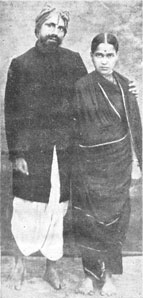
has expressed a deep experience of love in his Kannan
Songs – The lover and the Beloved. Chellamma was a source
of inspiration to him all his life. She married him at
the age of seven and lived with him for about twenty-four
years. In all these years she had accompanied him in his
unusual experiences. Like Kasturba, in the context of
Gandhi, she was subjected to various experiments by bharati,
and she had come through all of them. Not that she was
very intelligent at that young age, but as she was bought
up in village, in the atmosphere of a happy, married household,
where the wife obeyed her husband, and the age-long tradition
of an Indian woman who believed in living in harmony with
a husband, she was willing to do as the husband told her.
Later on, in her life with Bharati, she learn many things,
including reading and enjoyment of poetry.
Bharati
believed strongly in the quality of the sexes,. He regarded
the inferior place what women were given in the social
structure as barbaric, that came in the interim period
of British rule. Bharti used to walk with his wife holding
her hands in the ettayapuram streets, to go to the Raja
gardes. In those times, this was considered a very unusual
behaviour indeed. Bharati always acted according to what
he though and said was right.
Bharati
used to sing or read his poems to his wife and daughters
as soon as he finished composing them. Chellamma and the
daughters used to sing his poems as the poet himself taught
them. Bharati was an excellent musician; he was well-versed
in Karntatak and Hindustani styles of music. He enjoyed
the music of Thyagaraja, and other composers as he knew
very well the language of composition, Tellugu. Sometimes
he would sing Hindi bhajans, the ragas of which he loved
greatly. Those who have listened to Bharti’s songs as
they were sung and set to music by the poet himself would
well realize the distinct flavour of the poet’s musical
talent. Bharati was very fond of experimenting with different
musical notes, and the combinations were often so novel
that the song took an altogether new form in the manner
in which the poet set the piece to music. Chellamma too
was talented in music as she was brought up in an atmosphere
of music, and used tossing Bharati’s song till the day
of her death, at the age of sixty-three. She had a surprising
gift of memory for Bharati’s poetry, and was able to identify
many of Bharati’s original compositions.
It
may be surmised that in many ways Chellamma was an extra
ordinary woman. As she lived with Bharti for more that
two decades, she developed many qualities that most women
would envy. Her courage is worth mention, and, after Bharati,
the way she faced the varied problems of life was little
short of amazing. The courage, faith in God and essential
goodness, an optimistic view of life-qualities which she
developed were exactly the same as her husband’s. In my
seventeen years of life with her, I had never onced seen
her despairing in and situation. She would recite Bharati’s
poems quite often, as village women in our country recite
old sayings frequently, to find strength and enlightenment
for herself. Just befor she died, she spoke of Bharati
and sang the following two lines even when she had become
partially unconscious:
I came but to wait and serve Him
and He made me the famed minister….
Bharati had deep and enduring love for his family. As
a man his love for his wife and parental affection for
his daughers were similar to any man’s love of his family.
But a poet’s love runs to extremes. For example, Bharati
loved his elder daughter Thangamma so greatly- and she
was beautiful and intelligent-that he would have here
marry the prince of Germany. He did not listen to the
people of the village or other relatives who gossiped
in vain about his keeping her unmarried even after she
had come of age, thinking that she should marry at the
proper age a person whom she wanted to marry. Ironically,
it so happened that the daughter was married with the
help of Bharati’s brother. Viswanatha Iyyer. The bridegroom
was brought to Bharati for approval and Bharati was happy
to see that he was good looking, healthy and had sharp
eyes. Bharati performed all the rites of the marriage
of his daughter with a great deal of enthusiasm, chanting
the mantras from the depth of his heart.
The younger daughter, Sakuntala, was very active, unlike
her sister who was by nature very quiet and unassuming.
Bharati was very fond of the name Sakukntala, the heroine
of Kalidas’s Sakuntalam. As Sakuntala was born when Bharati
was reading Sakuntalam, he named his daughter after the
heroine of the play. Bharati would on occasion sit on
the first floor of the house, a footless structure, and
look at the morning sky, the birds and life gathering
momentum on the street below. Bharati’s poem “ Morning”
was the outcome of one such occasion in which, as the
daughter Sakuntala described what was happening outside,
the factual description was rendered into verses by the
father.
Bharati has mentioned some of his friends in his essays
and stories. He calls them by nick-names, partly humorously
as well as with a veiled truthfulness. “ Vilakkennai “
Chettair (Sabapath) who owned Bharati’s house never asked
him for payment of rent. He was so good and compassionate
that even if he had to ask Bharati for money \he would
not be able to do so. Instead he would listen to Bharati’s
songs and go back without asking anything. Bharati called
him “Vilakkennai : (castor oil) as his nature was so uncertain
as to reflect smoothness of his namesake.
There were “ Vellachu “ (jaggery piece) Krishnasamuy Chettiar,
“ Elikkunju “ (mouse) Chettiar (Armugam Chettiar), “ Valluru”
(kite) Naicker, Brahmaraya Iyer (Professor N. Subramania
Iyer)—who became characters in Bharati’s wirtings. Mandayam
Srinivasachariar, Sundaresa Iyer and S. Duraisamy Iyer
were among Bharati’s friends who helped him in numerous
ways. Though Sundaresa Iyer was very poor himself, he
helped ;Bharati as a true friend would in times of necessity.
Bharati was so close to him as to compose the poem beginning
‘ How have you been gone ‘ in his absence.
In spite of such an array of loyal friends the Pondicherry
police began actively preventing help or money reaching
the poet. The incidents responsible for such tightening
of controls were the assassination of sub-collector Ashe,
and the suicide of the patriot-assessing, Vanchinathan.
During such difficult periods. Bharati had the good fortune
of some friendships. His friends were courageous enough
to help him even at the risk of their own involvement
with the police. Such heroic men were Sundaresa Iyer,
Kalavaia Sankara Chettiar, and Ponnu Murugesam Pillai.
The whole family, including his wife and sons, of Murugesam
Pillai was devoted to Bharati. Bharati was one of them
indeed and was free to do as he pleased in their house.
Anni Ammal, the wife of Murugesam Pillai, took a motherly
care of Bharati, giving him food whenever he came. Unfortunately
the life of the family ended tragically. Raja Bahadur,
the eldest son, was sent to Paris for his studies in engineering.
At the point of his return the world war broke out and
Murugesam Piollai received a telegram carrying the message
that the ship in which his son traveled was destroyed
by the Germans Mufrugesam Pillai dies soon after, and
Raja Bahadur arrived on the twenty-seventh day of his
father’s death.
Ammakkannu was a faithful servant in Murugesam Pillai’s
hous and had a great affection for Bharati. She could
be trusted with anything, including taking care of Bharati’s
family at the time when his house and movemnts were closely
watched by the police.
Among Bharati’s compatriots, C.O. Chidambaram Pillai was
a close and noteworthy friend. Bharati helped him establish
the Swadesi Shipping company, which failed later. When
V.O. Chidambaram Pillai was arrested on the orders of
collector Which at Tirunellveli, and sentenced to forty
years in prison, Bharati was greatly upset. The poems
he composed as the imaginary conversations between V.O.
Chidambaram Pillai and the collector are full of patriotic
fervour and show Bharatis understanding of the cultural
history of India and the psychology of British tyranny.
Subramaniya Siva was another fried of Bharati, who went
to jail for then years for the fault of loving his country,
and on his release started a monthly “ Gnana Bhanu “ in
the year 1913. Bharati contributed to “ Gnana Bhanu “
regulary; Chinna Sankaran Kathai was published (only six
chapters ) in “ Gnana Bhanu “ every month. His poems “
Gnana Bhanu (Surya Sthomam), “ Yoga Siddhi ” , “Olium
Irulum “, “ Madhu ” , “ Kannan – En - Thai ”, “Veinkuzhal
“, “Pappa Pattu ” and “ Iravamai ” appeared in “ Gnana
Bhanu “. V.Ramasamy Iyengar and Bharati Dasan (Kanaka
Subburathinam) were among Bharati’s admirers. Bharati
Dasan, as a follower of Bharati tradition in the history
of Tamil literature, is an important sequence.
Parali S. Nellaiyappar was a publisher and one Bharati’s
close friends. He published a collection of Bharati’s
poems in 1917, under the title Nattuppattu, and published
a second edition in 1919. Bharati’s many letters to Nellaiyappar
regarding the publication of his works are available today.
Bharati’s letters may be regarded as pieces of literature
and as revealing his poetic personality. Bharati’s letters
show him as a great patriot and love of his language.
In a letter to his wife from Varanasi Bharati advises
Chellamma to learn, to read and write well in Tamil. In
another letter to his brother Viswana-than he asks him
not to write in English, but to write in Tamil or Sanskrit.
Bharati disclosed his ideals as well as his love of the
Tamil people and language in one of his letters to Nellaiyappar:
Brother, mind is the world.
Arise, arise, arise,
Away, upwards, and far, far away.
Burst with laughter at the sight of
old superstitions, fools who are trying
to hold their positions by mean of ropes.
Let there be wings for you! Fly away !......
The letter he wrote to M. Raghava Iyengar (October 18,1907)
is remarkable for its simplicity of expression and patriotic
fervour. Bharati called ‘patriotism’ a ‘new flame’ as
it was capable of dispelling the darkness of slavery.
Bharati, saluting these flame in the heart of M. Raghava
Iyengar, writes:
I
prostrate before the flame of patriotism kindled in the
purity of your heart. You say that the wheel of time goes
round in the end. Yes: the wheel turns indeed. In that
revolving, the time has come when the humiliated India
will be replaced by Maha Bharatam (the Grand India). The
fire in your heart will lead the Indians now drowned in
the darkness of humiliation towards the grand concept
of Mother India. I salute this fire. May it prosper.
Bharati’s foresight did not fail; as the wheel of time
turned, the flame of patriotism kindled in the hearts
of many thousands of Indians, and brought her freedom.
Though Bharati did not live to see his country liberated
from foreign rule, a poet’s vision has the streaks of
immortality which blends the past and the future in the
unity of the present.
4