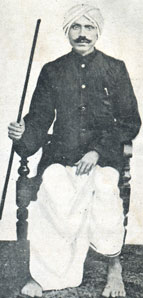
Mahakavi Bharati had written himself into the history of India. The Poet's prophetic consciousness manifested itself as "Psalms of Patriotism," hailed ever since as "Desopanishad."
Sarojini Naidu declared: "Bharati kindled the souls of men by the million to a more passionate love of freedom and a richer dedication to the service of the country." Fully alive to the multifoliate splendour of Bharati, Jawahar lal Nehru affirmed: "Bharati is not only the poet of Tamil Nadu, he belongs also to the whole India. His verses should be published in all the Indian languages." A similar appeal couched in impassioned words was made by Bharatidasan, decades ago. "Bharati's vastitudes can be known only when the poems of the great one, in Tamil, are translated into the languages of the world." This volume, we daresay, marks the partial fulfilment of Paventar's noble dream.
Byron and Shelley -- the true soldiers of Goddess Liberty -- were in. some measure the inspirers of the Mahakavi, who in all humility, called himself Shelleydasan. Prof. K.Swaminathan's dictum in this connection is significant. "In the course of his evolution from Shelleydasan as he used to describe himself earlier, to Saktidasan (devotee of Sakti, Goddess of Energy), Bharati reflected the great change which transformed, India, a British dependency into a self-reliant power."
Bharati authored the New Poetry in Tamil, which in the words of Prof. K.R.Srinivasa Iyengar, was "at once radiantly autochthonous and bracingly modern." From a mere versifier, he grew, in no time, to be an authentic poet of mysticism by his willing submissions to the compelling rhythm of a larger life. He was able to push back the barricades of the self, one by one, till at last, his life became one of intuitive love. "Love" said the poet, "is my religion," and no one practised it as the poet did. His incandescent and piercing intellect burnt all dichotomies away. Everything that he beheld was nothing but "the ardent self-expression of that Immanent Being," a lila, a musical manifestation of creative joy. Kaakkai and Kuruvi, "the scuttering insects, the little soft populations of the grass," Katal and Malai and all things animate as well as inanimate, were his comrades and his intense love asserted itself in the most suasive way in every one of his poems. To read his poem is to feel the beating of a benign heart, the upleap of a beatific joy -- greater, vaster and richer than anything that one has known. By cultivating Bharati, the aspirant will, sooner or later, discover his fraternal link with all things; he will by and by perceive in the Many the clear and palpable presence of the One: "the changeless and absolute Life, manifesting itself in all the myriad nascent, crescent, cadent lives."
Any translation is but an experiment. A work worth translating has about it a charm that defies transplantation. The lustre of the original grows pallescent in the hands of even the ablest of translators. What is achievable and is usually achieved by a trained hand, is only readability coupled with dependability. If this is made possible, the translator has not flexed his transcreative muscle in vain.
This work which contains the complete English version of the Mahakavi's poems as well as prose poems, is the fruit of the collective endeavour of a number of savants. For the first time, the reader has before him the Englished version of all the poems of Bharati -- the Bard of Bharat. The Tamil University merits no mean accolade for this achievement. It has already brought out an edition of the poems of Bharati in Tamil, chronologi cally arranged. This work in English punctiliously follows the Tamil edition. A few poems, however, are omitted as they are not from the quill of Bharati's.
The craftsmanship of Bharati, as revealed by his juvenilia, is pretty conventional and is rather dull. However, as years roll by, his irresistible genius starts asserting itself with a wondrous splendour that is truly multi dimensional. The myriad-minded bard's apperception is achieved with a thousand tentacles of awareness and his utterances -- afire with burning desire --, shoot out like piercing pins of light. His words and vocables ener gised by a novel poetic fervour, march out, suaviter in modo, fortiter in re, and make a universal conquest.
Almost all the translators of Bharati are represented in this work. Each one in his own way has endeavoured to bring alive in his translation the spirit of the original. Our selection is informed by the sincerity of purpose which has guided each one of them in his labour of love.
Bharati has translated the poems of Sri Aurobindo, John Scurr and Rabindranath Tagore. He has also translated a couple of lines from H.W.Longfellow. His Tamil versions of these poets form part of his poetical works. We have therefore included in this volume the originals. As the poem of Tagore is not traceable, I have done the translation in this connection.
Prof. A.E.Asher has gone through the work with sympathy and understand ing. Thanks to his suggestions and corrections, the work is no longer marred by major flaws.
We have provided useful and brief notes wherever necessary. An index to the first lines of the Tamil poems is appended to this volume. It is not alphabetically arranged. However it is in accordance with the order of the poems (Tamil as well English) as published by the University. This will facilitate easy reference.
We render our heart-felt thanks to Dr. S.Agesthialingom, the revered Vice-Chancellor of the Tamil University, for conceiving, processing and implementing the grand scheme of "TRANSLATION: TAMIL WORKS."
We render our special thanks to Thiru Seeni Viswanathan for having helped us in the preparation of the Reading List appended to this volume.
This volume -- so are we prone to think --, typifies the tribute of the devotees of Tamil to Mother Tamil and Her son -- Bharati, the Mahakavi.
Thanjavur,
20-7-1989. |
Sekkizhar Adi-p-Podi
T.N.Ramachandran |